.png?width=160&height=46&name=FMC%20logo%20(6).png "FMC logo")



Is your sales team still guessing which deals will close?
The days of relying on gut feelings, rep intuition, and hopeful forecasts are over. In 2026, predictive CRM analytics has evolved from a "nice-to-have" competitive advantage into an essential foundation for high-performing sales organizations. The difference between companies hitting their targets and those consistently falling short often comes down to one thing: the ability to accurately predict outcomes and act on those predictions.
According to recent research, predictive sales forecasting typically improves accuracy by 20-30% compared to traditional methods. While traditional forecasting often misses targets by 10% or more, data-driven predictive models can achieve 75-95% accuracy when properly implemented. For a sales team generating $10M annually, that improvement in accuracy can mean the difference between $1M in missed revenue or exceeded targets.
But predictive analytics isn't just about better forecasts—it transforms how sales teams prioritize leads, allocate resources, identify at-risk deals, and coach reps to success. In 2026, AI-powered predictive systems analyze thousands of data points simultaneously, uncovering patterns invisible to human analysis and delivering actionable insights in real-time.
This article explores how predictive CRM analytics is revolutionizing sales in 2026—and how your team can leverage these capabilities to boost performance, shorten sales cycles, and consistently exceed quotas.
What Is Predictive CRM Analytics?
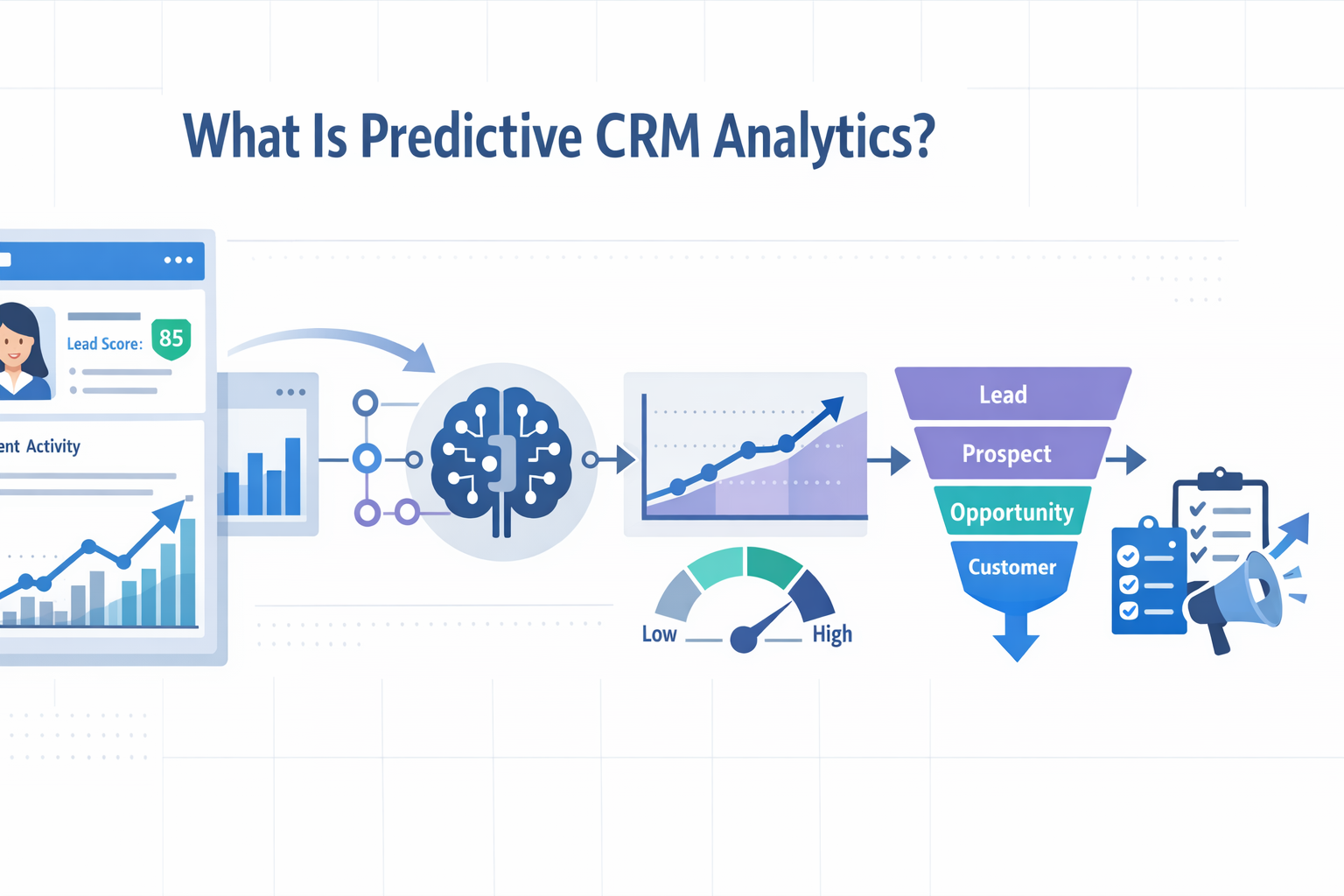
Predictive CRM analytics uses artificial intelligence and machine learning to analyze historical data, identify patterns, and forecast future outcomes with remarkable accuracy.
Traditional Forecasting vs. Predictive Analytics
| Aspect | Traditional Forecasting | Predictive Analytics |
|---|---|---|
| Data sources | Sales rep estimates, historical revenue | CRM data, engagement patterns, behavioral signals, external factors |
| Analysis method | Manual spreadsheets, gut feelings | Machine learning algorithms processing thousands of variables |
| Accuracy | 60-75% (misses targets by 10%+) | 75-95% when properly implemented |
| Update frequency | Weekly or monthly | Real-time, continuous learning |
| Question answered | "What happened last quarter?" | "What's most likely to happen next?" |
| Bias | Subject to human optimism/pessimism | Data-driven, eliminates emotional bias |
How Predictive Analytics Works
Step 1: Data collection
The system continuously gathers data from your CRM including deal history, customer interactions, email engagement, meeting notes, pipeline changes, and win/loss patterns.
Step 2: Pattern recognition
Machine learning algorithms analyze this data to identify patterns invisible to human analysis—such as the specific combination of activities that correlate with closed deals or the early warning signs that predict deal failure.
Step 3: Modeling
The system builds predictive models that assign probability scores to various outcomes: likelihood a lead will convert, probability a deal will close, risk that a customer will churn, optimal timing for outreach.
Step 4: Continuous learning
As new data enters the system, the algorithms refine their models, becoming more accurate over time. Every closed deal teaches the system something new.
Step 5: Actionable insights
Rather than presenting raw data, predictive analytics surfaces specific recommendations: which leads to prioritize today, which deals need immediate attention, what actions are most likely to move opportunities forward.
The AI Revolution in 2026
In 2026, predictive analytics has evolved from analyzing historical patterns to anticipating future needs in real-time. Modern systems integrate broader signals like seasonality, market trends, and buyer intent to refine accuracy. They don't just tell you what might happen—they recommend exactly what to do about it.
As one industry analyst noted, in 2026, forecasts use historical data, behavioral patterns, and current signals to derive probabilities. This changes how teams prioritize the funnel and the quality of forecasts.
Why 2026 Is the Tipping Point
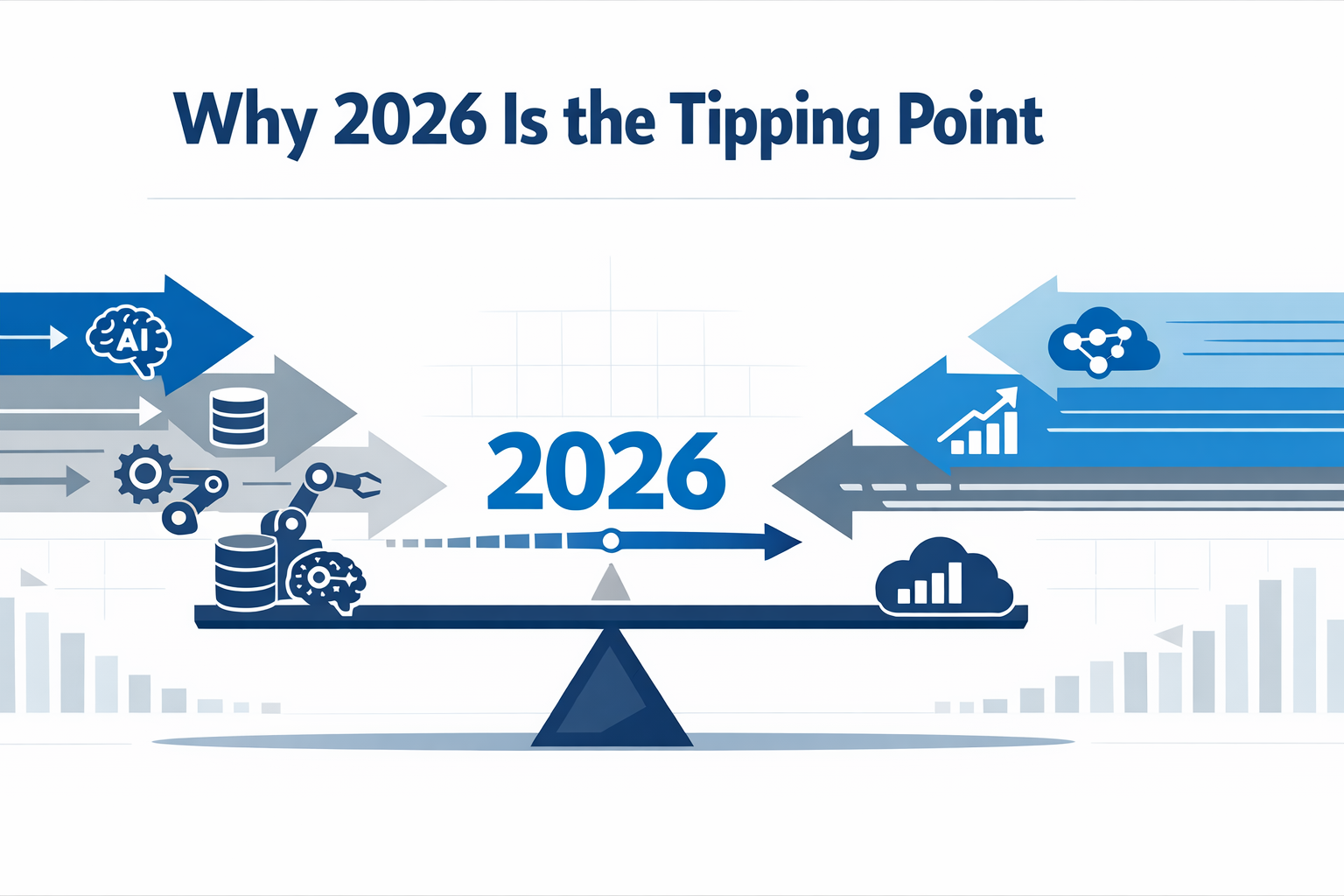
Several converging factors make 2026 the year predictive CRM analytics moves from competitive advantage to absolute necessity.
The Market Forces Driving Change
1. Buyer behavior transformation
B2B buyers in 2026 arrive at sales conversations significantly better prepared. They've already completed 60-70% of their buying journey independently through research, peer reviews, and self-service content. Sales teams must engage with precision—no room for generic pitches or wasted outreach.
2. Data saturation
CRMs are filled with more data than ever before. But a CRM saturated with data is only valuable if it provides clear, actionable foresight rather than retrospective guesswork. Companies drowning in data but starving for insights desperately need predictive analytics to make that data useful.
3. Economic pressure
Economic uncertainty demands efficiency. Companies can no longer afford to have reps chasing low-probability deals or managers building forecasts on hopeful assumptions. Predictive analytics ensures resources flow to the highest-return activities.
4. AI maturity
AI has moved from pilots to production. Organizations have trained systems, established processes, and seen proven results. The technology is no longer experimental—it's reliable and accessible.
5. Competitive necessity
As research shows, organizations using monday CRM report shorter sales cycles, improved forecast accuracy, and better alignment across revenue teams. Companies without predictive capabilities are increasingly outpaced by competitors leveraging these insights.
The Shift from Retrospective to Predictive
For years, sales forecasting was one of the weakest disciplines in sales—retrospective, subjective, and heavily influenced by individual assessment. In 2026, that picture is shifting. Predictive analytics uses historical data, behavioral patterns, and current signals to derive probabilities, transforming how teams prioritize the funnel and forecast quality.
Instead of treating all opportunities equally, risks and potentials become visible earlier. Stagnating deals stand out faster, while opportunities with high closing probability receive targeted attention.
The 8 Ways Predictive Analytics Boosts Sales
1. Laser-Focused Lead Prioritization
The challenge:
Sales reps face overwhelming numbers of leads. Without guidance, they often pursue whoever contacted them most recently or whoever seems friendliest—not necessarily who's most likely to buy.
How predictive analytics helps:
AI-powered lead scoring automatically prioritizes prospects based on engagement patterns, company fit, and conversion likelihood. The system analyzes thousands of data points to identify which leads are genuinely ready to buy.
Real-world impact:
Imagine starting your day with an AI-generated dashboard. Instead of manually sorting through a list of leads, the AI has already ranked them for you, highlighting those with the highest likelihood of closing based on thousands of data points.
The AI might flag a lead because:
- Their industry just received significant investment capital
- Their recent website activity indicates they're close to a purchase decision
- Their engagement pattern matches your most successful conversions
- Their company size and tech stack perfectly fit your ideal customer profile
The result:
Reps focus time on leads most likely to convert, increasing conversion rates while reducing wasted effort on low-probability prospects.
Platform example:
monday.com CRM provides AI-powered lead scoring and qualification that automatically prioritizes prospects so teams focus on deals most likely to close.
2. Accurate Revenue Forecasting
The challenge:
Traditional forecasting relies on rep estimates that are inevitably biased by optimism, pessimism, or lack of complete information. Leadership makes strategic decisions based on forecasts that miss by 10-15%, creating cash flow issues and misaligned resource allocation.
How predictive analytics helps:
Instead of asking reps to estimate close probabilities, AI analyzes actual historical patterns—how deals at specific stages with certain characteristics actually performed. It considers deal velocity, engagement levels, competitive dynamics, and dozens of other factors invisible in manual analysis.
Accuracy improvements:
Predictive models typically achieve 75-95% forecast accuracy, compared to 60-75% with traditional methods. For a company with $10M in quarterly revenue, improving accuracy from 70% to 85% means the difference between missing targets by $300K or exceeding them by $150K.
Real-time adjustments:
In 2026, sales forecasting is a science driven by AI that analyzes not only CRM data but also external factors such as market trends, customer behavior, and even global economic changes. If a major competitor launches a new product, AI immediately factors this into forecasts and provides insights needed to adjust strategy on the fly.
Platform example:
Zoho CRM's Zia AI acts like a built-in forecasting analyst, predicting revenue outcomes based on past performance, deal stages, and sales velocity.
3. Early Risk Detection
The challenge:
Deals stall for countless reasons—ghosting prospects, budget freezes, competitive losses, internal champion departures. By the time these problems surface through traditional pipeline reviews, it's often too late to recover.
How predictive analytics helps:
AI monitors engagement patterns and identifies early warning signals: decreased email responsiveness, missed meetings, lack of multi-threading with stakeholders, extended periods without advancement. The system flags at-risk deals while there's still time to intervene.
Proactive intervention:
Instead of discovering deal problems during quarterly business reviews, managers receive real-time alerts about at-risk opportunities with recommended next actions. This transforms sales management from reactive to proactive.
Common risk indicators detected:
- Engagement drop-off (prospect stops responding)
- Single-threaded relationships (only one stakeholder involved)
- Extended time in stage (deal hasn't progressed in 2+ weeks)
- Missing key activities (no demo scheduled, no proposal sent)
- Competitive threat signals (prospect researching alternatives)
- Champion change (primary contact leaves company)
The result:
Managers intervene early with targeted coaching or strategic moves, recovering deals that would otherwise slip away.
4. Intelligent Deal Recommendations
The challenge:
Even experienced reps sometimes struggle to know the optimal next step for each deal. Should they send more information? Schedule an executive meeting? Offer a discount? Wait for the prospect to re-engage?
How predictive analytics helps:
By analyzing thousands of successful deals, AI identifies which actions at which stages correlate with winning. The system provides specific recommendations: "Based on similar deals, scheduling a technical demo within the next 3 days increases win probability by 34%."
Prescriptive guidance:
The integration of AI will deepen, with predictive systems moving from predictive insights to prescriptive guidance—recommending the specific actions needed to win a deal, such as adjust pricing by 8%, schedule an executive presentation, or offer a trial extension.
Real-time coaching:
During customer conversations, AI can analyze the discussion in real-time, pull relevant data, and suggest talking points. It's like having an expert coach whispering advice during every sales call.
Platform example:
Pipedrive CRM provides an AI Sales Assistant that continuously analyzes pipelines and activities to predict win probability and recommend next steps.
5. Optimal Timing Insights
The challenge:
Timing matters enormously in sales. Contact a prospect too early and you're ignored; wait too long and a competitor wins. Most reps rely on arbitrary follow-up schedules ("I'll check back in a week") rather than data-driven timing.
How predictive analytics helps:
AI identifies optimal contact times based on prospect behavior patterns, industry trends, and historical success data. The system might recommend: "This prospect typically responds to emails sent Tuesday mornings" or "Similar deals close fastest when proposals are sent within 48 hours of demo."
Engagement optimization:
Rather than generic follow-up schedules, reps receive intelligent recommendations about when prospects are most likely to engage—maximizing response rates while respecting prospect preferences.
The efficiency gain:
AI schedules follow-up appointments with potential customers based on optimal contact times, automatically updates CRM with insights from recent interactions, and even designs emails tailored to each recipient's communication style.
6. Churn Prediction and Prevention
The challenge:
Losing existing customers is far more expensive than acquiring new ones. But by the time churn signals are obvious—non-renewal notices, support tickets, payment issues—it's usually too late to save the relationship.
How predictive analytics helps:
AI monitors customer health signals: product usage patterns, support interaction frequency, engagement with renewal communications, and payment behavior. The system identifies at-risk customers months before they churn, enabling proactive retention efforts.
Early intervention:
Zoho CRM can identify and mitigate the risk of customer churn through churn scores. For subscription-based records, it also indicates the specific product or service from which a customer might churn.
Retention strategies:
Predictive analytics doesn't just flag risk—it recommends retention strategies based on what worked with similar customers: executive business reviews, product training, feature demonstrations, or pricing adjustments.
The financial impact:
For a SaaS company with $5M ARR and 10% annual churn, reducing churn by just 3 percentage points through predictive intervention saves $150K annually—and that number compounds every year.
7. Data-Driven Coaching
The challenge:
Sales managers struggle to provide effective coaching when they lack objective data about rep performance. Traditional coaching relies on subjective observations and quarterly reviews that come too late to help struggling reps.
How predictive analytics helps:
AI identifies patterns in rep activity that correlate with success or failure. Managers see exactly which behaviors drive results: number of discovery calls, depth of multi-threading, quality of needs analysis, or proposal customization level.
Real-time feedback:
Sales coaching in 2026 is no longer limited to debriefings or quarterly training sessions. During customer conversations, AI analyzes the conversation in real-time, offering coaching suggestions to help reps navigate objections, emphasize key points, or adjust their approach.
Personalized development:
Rather than generic training, predictive systems identify each rep's specific improvement opportunities. One rep might need help with objection handling while another needs to improve follow-up consistency.
Platform example:
Salesforce's Einstein AI provides deal-level insights and coaching recommendations that help managers identify which reps need support and exactly where to focus development efforts.
8. Cross-Sell and Upsell Opportunities
The challenge:
Sales teams often miss expansion opportunities within existing accounts because they lack visibility into customer needs, product usage, or readiness for additional solutions.
How predictive analytics helps:
AI analyzes customer behavior patterns, product usage data, and company growth signals to identify accounts most likely to expand. The system recommends specific products or services based on what similar customers have successfully adopted.
Proactive expansion:
Rather than waiting for customers to request more, predictive analytics enables sales teams to proactively identify accounts showing buying signals for additional products—and reach out at precisely the right moment with the right offer.
The revenue impact:
Intelligent cross-sell and upsell recommendations typically increase expansion revenue by 15-30% compared to reactive approaches. For a company with $10M in existing customer revenue, that represents $1.5-3M in additional annual revenue.
Customer success alignment:
Predictive systems help customer success teams identify which accounts need attention to prevent churn and which are primed for expansion conversations—ensuring resources focus where they'll have the greatest impact.
How Leading CRM Platforms Deliver Predictive Analytics
Salesforce: Einstein AI
Salesforce leads the enterprise CRM market with Einstein AI, which provides sophisticated predictive capabilities across the entire platform.
Key predictive features:
- Einstein Lead Scoring: Automatically prioritizes leads based on conversion probability
- Einstein Opportunity Insights: Identifies at-risk deals and suggests actions to keep them moving
- Einstein Forecasting: Delivers accurate revenue predictions with confidence intervals
- Einstein Activity Capture: Automatically logs emails and meetings, feeding predictive models with complete interaction data
- Einstein Conversation Insights: Analyzes sales calls to identify what works and what doesn't
Best for: Enterprise organizations needing the most advanced predictive capabilities with deep customization options.
HubSpot: Predictive Lead Scoring
HubSpot has democratized predictive analytics for mid-market companies with built-in AI features that require no data science expertise.
Key predictive features:
- Predictive Lead Scoring: Automatically scores leads based on fit and engagement
- Deal Predictions: Forecasts which opportunities are most likely to close
- Contact and Company Insights: Enriches records with predictive data about company growth, technology usage, and buying signals
- Forecasting Tools: Fully integrated within HubSpot CRM with no connectors required
- AI-Powered Content Recommendations: Suggests which content to share with each prospect
Best for: SMBs and mid-market teams that need easy-to-use AI forecasting without complex setup.
Zoho: Zia AI
Zoho CRM provides powerful predictive analytics through Zia, their AI assistant that acts like a built-in analyst.
Key predictive features:
- Zia Lead and Deal Predictions: Forecasts which leads and deals are most likely to convert
- Best Time to Contact: Recommends optimal outreach timing for each prospect
- Anomaly Detection: Identifies unusual patterns that might indicate problems or opportunities
- Churn Prediction: Flags customers at risk of leaving with specific product-level insights
- Macro Suggestions: Recommends workflow automations based on repetitive patterns
Best for: Value-driven organizations wanting comprehensive predictive analytics at affordable prices.
monday.com: AI-Powered Work OS
monday.com CRM combines CRM with work management, providing predictive insights across the entire revenue operation.
Key predictive features:
- AI-Powered Lead Scoring and Qualification: Automatically prioritize prospects based on engagement patterns and company fit
- Predictive Deal Insights: Real-time alerts about at-risk opportunities with recommended next actions
- Intelligent Email Generation: Creates personalized outreach at scale with AI adapting messaging based on prospect data
- Automated Data Capture: Eliminates manual entry with AI extracting information from emails and meetings directly into CRM
- Unified Collaboration: Connects sales, marketing, and customer success teams around shared predictive insights
Best for: Revenue teams wanting flexible, customizable infrastructure that adapts to evolving sales processes while delivering AI-powered automation.
Pipedrive: AI Sales Assistant
Pipedrive CRM focuses on sales-first simplicity with increasingly sophisticated AI capabilities.
Key predictive features:
- AI Sales Assistant: Continuously analyzes pipelines and recommends which deals to prioritize
- Deal Win Probability: Predicts likelihood of closing based on historical patterns
- Smart Email Creation: Crafts personalized emails from simple prompts using CRM data
- Revenue Forecasting: Provides accurate predictions based on pipeline health and velocity
- Activity Recommendations: Suggests next actions proven to move deals forward
Best for: Sales-focused teams wanting intuitive pipeline management enhanced by practical AI assistance.
The Data Foundation: What Predictive Analytics Needs
Predictive analytics is only as good as the data feeding it. Here's what your CRM needs to deliver accurate predictions:
The Three Essential Data Types
1. Historical sales data
- Past deals (won and lost)
- Win/loss rates by segment, product, rep
- Sales cycle lengths
- Deal values and pricing patterns
- Historical forecasts vs. actual results
2. Customer data
- Demographics (industry, size, location)
- Purchase history
- Engagement patterns (emails, meetings, website visits)
- Product usage (for existing customers)
- Support interactions
3. Pipeline data
- Current deal stages
- Deal values and expected close dates
- Activities logged (calls, emails, meetings)
- Stakeholders involved
- Competitive situation
- Deal velocity (how quickly deals progress)
Data Quality Requirements
| Factor | Why It Matters | How to Ensure |
|---|---|---|
| Completeness | Missing data creates blind spots in predictions | Required fields, validation rules, regular audits |
| Consistency | Inconsistent definitions confuse algorithms | Standard naming conventions, dropdown fields vs. free text |
| Accuracy | Wrong data produces wrong predictions | Regular data cleanup, duplicate detection, enrichment |
| Timeliness | Stale data leads to outdated predictions | Real-time sync, automated updates, integration |
| Relevance | Irrelevant data adds noise | Focus on fields that actually predict outcomes |
The Data Quality Challenge
As one industry expert noted, predictive models are only as good as the data they're based on. Incomplete or inconsistent CRM data directly affects forecasts. Data quality becomes a strategic issue, not just a maintenance task.
Many organizations react by adding more required fields. More sustainable, however, is developing shared understanding of which information is truly decision-relevant at each point in the sales process.
Most Common Data Quality Issues
1. Unclear stage definitions
Different reps define "Qualified" or "Proposal" differently, making historical patterns meaningless.
Solution: Document clear criteria for each pipeline stage with specific entry and exit requirements.
2. Missing activity context
Logged activities without notes about what was discussed or decided provide little predictive value.
Solution: Use templates or prompts to capture key discussion points and outcomes.
3. Inconsistent lead sources
When lead source data is unreliable, predictive models can't identify which channels produce best results.
Solution: Automated lead source tracking with standardized values.
4. Outdated contact information
Stale stakeholder data means predictive systems can't assess whether deals are properly multi-threaded.
Solution: Regular enrichment from third-party data sources and automated validation.
5. Incomplete competitive intel
Without knowing who you're competing against, predictive models miss critical context.
Solution: Required competitive field with dropdown list of common competitors.
Real-World Success Stories
Success Story 1: SaaS Company Increases Close Rates 34%
Company: Mid-market SaaS provider, 40 sales reps, $25M ARR
Challenge:
Reps spent equal time on all leads, resulting in low conversion rates and long sales cycles. Forecasts consistently missed by 15-20%.
Solution:
Implemented HubSpot's predictive lead scoring integrated with sales workflows. AI automatically prioritized leads and provided daily focus lists for each rep.
Results:
- Lead-to-opportunity conversion increased from 8% to 11% (37.5% improvement)
- Average sales cycle shortened from 47 to 35 days (25% reduction)
- Forecast accuracy improved from 68% to 89%
- Overall close rate increased from 23% to 31% (34% improvement)
- Revenue per rep increased $180K annually
Key insight: "Our reps used to say they needed more leads. What they actually needed was better prioritization. Predictive scoring helped them focus on the 20% of leads that represented 80% of our revenue potential."
Success Story 2: Manufacturing Distributor Reduces Churn by 42%
Company: Industrial equipment distributor, 500+ enterprise customers, $60M annual revenue
Challenge:
Customer churn was costing $2.4M annually. By the time customers gave non-renewal notices, it was too late to save the relationship. The company had no early warning system.
Solution:
Deployed Zoho CRM with Zia's churn prediction capabilities. The system monitored 47 different customer health signals including order frequency, support tickets, payment patterns, and portal engagement.
Results:
- Identified at-risk customers an average of 4.3 months before expected churn
- Customer success team proactively reached out with targeted retention offers
- Churn rate reduced from 12% to 7% (42% improvement)
- Annual churn cost reduced from $2.4M to $1.4M (saved $1M annually)
- Customer lifetime value increased 18%
- Net promoter score improved from 32 to 51
Key insight: "The AI flagged customers we would have never suspected were at risk. In one case, a customer who'd been with us for 8 years was showing early warning signs we completely missed. We intervened with an executive business review and saved a $120K annual account."
Success Story 3: Financial Services Firm Doubles Cross-Sell Revenue
Company: Wealth management firm, 50 advisors, 2,500 high-net-worth clients
Challenge:
Advisors focused on new client acquisition while missing significant expansion opportunities within existing relationships. Cross-sell revenue was only 15% of total revenue despite having multiple relevant products.
Solution:
Implemented Salesforce with Einstein AI to identify cross-sell opportunities. The system analyzed client portfolios, life events, account activity, and product fit to recommend specific expansion opportunities for each advisor.
Results:
- Cross-sell revenue increased from $4.5M to $9.2M annually (104% growth)
- Average revenue per client increased 38%
- Client satisfaction improved (clients appreciated proactive, relevant recommendations)
- Advisors spent 60% less time researching cross-sell opportunities
- Win rate on cross-sell proposals increased from 31% to 54%
Key insight: "Einstein essentially gave each advisor a research analyst who knew every client intimately and could identify the perfect moment to introduce additional services. The recommendations were so accurate that our advisors' trust in the system grew quickly."
Success Story 4: Tech Startup Achieves 89% Forecast Accuracy
Company: B2B SaaS startup, 15 sales reps, Series B funded, scaling rapidly
Challenge:
As a rapidly growing startup, accurate forecasting was critical for board reporting, hiring decisions, and cash flow management. Traditional rep-based forecasting was wildly inaccurate, varying by 25-40% from actuals.
Solution:
Deployed Pipedrive CRM with AI Sales Assistant to provide data-driven revenue predictions based on pipeline health, deal velocity, and historical patterns rather than rep estimates.
Results:
- Forecast accuracy improved from 62% to 89% within 3 months
- Board confidence in projections increased significantly
- Hiring decisions based on accurate growth projections
- Cash runway planning became reliable
- Investor relations improved with consistent delivery vs. forecast
- Sales leadership could focus on coaching rather than forecast debates
Key insight: "Before predictive analytics, our forecast meetings were debates about optimism vs. pessimism. Now they're strategic discussions about how to accelerate the deals we know are real and save the ones showing warning signs."
Success Story 5: Enterprise Software Company Shortens Sales Cycle 31%
Company: Enterprise software vendor, 120 sales reps, complex 6-12 month sales cycles
Challenge:
Long sales cycles made it difficult to identify which deals were progressing healthily vs. which were stalled. Reps often discovered deal problems too late to recover.
Solution:
Implemented monday.com CRM with AI-powered deal insights that monitored engagement patterns, stakeholder involvement, and activity completion to flag deals needing attention.
Results:
- Average sales cycle shortened from 8.2 months to 5.7 months (31% reduction)
- Deal stagnation identified average 6 weeks earlier than before
- Win rate increased from 28% to 37% (32% improvement)
- Pipeline velocity increased 45%
- Revenue per rep increased $340K annually
- Sales and customer success alignment improved with shared visibility
Key insight: "The AI acted like an early warning system. When engagement dropped or we weren't multi-threading properly, we got immediate alerts with specific recommendations. This transformed our ability to keep deals moving."
Implementing Predictive Analytics: A Practical Roadmap
For organizations ready to leverage predictive CRM analytics, here's a proven implementation framework:
Phase 1: Foundation and Assessment (2-4 weeks)
Week 1-2: Data audit
- Evaluate current CRM data quality and completeness
- Identify gaps in historical data
- Assess integration needs with other systems
- Document current forecasting process and accuracy
Week 3-4: Goal setting and platform selection
- Define specific objectives (improve forecast accuracy by X%, increase conversion by Y%)
- Evaluate CRM platforms based on predictive capabilities needed
- Identify key stakeholders and secure executive sponsorship
- Establish baseline metrics for comparison
Critical questions to answer:
- What specific decisions will predictive analytics improve?
- Which sales challenges cause the most revenue loss?
- What's our current forecast accuracy and what target is realistic?
- Do we have adequate historical data (typically need 6-12 months minimum)?
- Which team members will champion adoption?
Phase 2: Data Preparation (3-6 weeks)
Clean and standardize:
- Remove duplicate records and merge accounts
- Standardize field naming and values
- Define clear pipeline stage criteria
- Establish data entry standards and required fields
- Implement validation rules
Enrich and complete:
- Fill gaps in historical records where possible
- Integrate third-party data sources for company enrichment
- Capture missing contact information
- Document deal outcomes (won/lost reasons)
- Ensure activity logging completeness
Data quality checklist:
- [ ] Duplicate contact rate below 5%
- [ ] All opportunities have clear stage definitions
- [ ] Win/loss data captured for 90%+ of closed deals
- [ ] Lead sources consistently tracked
- [ ] Key decision-makers identified for each opportunity
- [ ] Activity logging meets minimum frequency standards
- [ ] Product/service categories standardized
Phase 3: Initial Model Training (4-8 weeks)
Configure predictive features:
- Enable lead scoring in your chosen CRM platform
- Set up opportunity scoring and forecasting
- Configure churn prediction (if applicable)
- Establish baseline prediction thresholds
Train and calibrate:
- Allow AI to analyze historical patterns (typically 6-12 months of data)
- Review initial predictions against known outcomes
- Adjust scoring factors and weights as needed
- Calibrate confidence thresholds
Integration setup:
- Connect CRM to email, calendar, and communication tools
- Integrate with marketing automation for complete engagement data
- Link to customer success platforms for health scoring
- Establish data flows from external systems
Validation process:
- Compare AI predictions to actual outcomes for recent closed deals
- Identify patterns where predictions were most/least accurate
- Refine model parameters based on validation results
- Document prediction accuracy by deal segment
Phase 4: Pilot Program (6-8 weeks)
Select pilot team:
- Choose 3-5 reps representing different experience levels
- Include at least one sales manager in pilot
- Select mix of high and average performers
- Ensure pilot team is open to new approaches
Deploy and monitor:
- Provide comprehensive training on predictive features
- Shadow reps during initial usage
- Gather daily feedback on usability and accuracy
- Track key metrics: forecast accuracy, conversion rates, sales cycle length
Iterate and improve:
- Weekly check-ins with pilot team
- Adjust workflows based on feedback
- Refine scoring thresholds
- Document best practices emerging from pilot
Pilot success metrics:
- Forecast accuracy improvement of 10-15 percentage points
- Conversion rate improvement of 20-30%
- Positive user feedback on usability
- Demonstrated time savings in prioritization
- At least 75% of pilot team actively using predictions
Phase 5: Full Deployment (8-12 weeks)
Rollout plan:
- Deploy to broader team in phases (by region, product line, or team)
- Provide role-specific training for reps, managers, and executives
- Create quick-reference guides and video tutorials
- Establish support channels for questions
Change management:
- Communicate the "why" behind predictive analytics clearly
- Share pilot team success stories
- Address concerns and resistance proactively
- Celebrate early wins publicly
- Provide ongoing coaching and support
Performance tracking:
- Establish weekly dashboard reviews
- Track adoption metrics (percentage of reps using predictions)
- Monitor accuracy improvements over time
- Measure impact on key business outcomes
- Conduct monthly retrospectives
Full deployment milestones:
- 90%+ of team actively using lead/opportunity scores
- Forecast accuracy improved 15-25 percentage points
- Sales cycle shortened 15-30%
- Conversion rates improved 20-35%
- Positive ROI demonstrated within 6 months
Phase 6: Continuous Improvement (Ongoing)
Monthly optimization:
- Review prediction accuracy by segment
- Identify new factors to incorporate
- Adjust scoring weights based on outcomes
- Incorporate new data sources as available
Quarterly strategic reviews:
- Analyze aggregate trends and patterns
- Share insights with leadership
- Identify new use cases for predictive analytics
- Expand to additional sales processes
Advanced capabilities:
- Implement more sophisticated models as data accumulates
- Add new prediction types (optimal pricing, deal size forecasting)
- Integrate with other business systems
- Explore industry-specific prediction models
Common Mistakes to Avoid
Mistake 1: Insufficient Data Quality
The problem:
Implementing predictive analytics on top of messy, incomplete data produces unreliable predictions that teams quickly stop trusting.
The fix:
Invest time upfront in data cleanup and standardization. Predictive models are only as good as the data they're based on. Establish clear data entry standards and enforce them consistently before enabling predictive features.
Warning signs:
- Duplicate contact rate above 10%
- More than 30% of deals missing key information
- Inconsistent use of picklist values
- Activities logged without context
- Conflicting data across integrated systems
Mistake 2: Treating Predictions as Certainty
The problem:
Teams interpret AI predictions as guarantees rather than probabilities, leading to poor decisions when predictions prove incorrect.
The fix:
Educate teams that predictions are probabilistic, not deterministic. A deal with 80% win probability still fails 1 in 5 times. Use predictions to inform decisions, not replace judgment.
Best practice:
Always show confidence intervals. Instead of "This deal will close for $50K," display "This deal has a 75% probability of closing for $45K-$55K."
Mistake 3: Ignoring the Human Element
The problem:
Relying entirely on AI predictions while disregarding rep intuition and customer relationships leads to missed context that algorithms can't capture.
The fix:
Position predictive analytics as augmenting human judgment, not replacing it. Encourage reps to provide feedback when predictions seem wrong—this input helps refine models while maintaining rep engagement.
The balance:
The best sales teams in 2026 combine data-driven insights with relationship intelligence. AI tells you what's likely to happen; humans understand why and can influence outcomes.
Mistake 4: Analysis Paralysis
The problem:
Teams become so focused on analyzing predictions that they fail to take action. Endless discussions about forecast accuracy replace actual selling.
The fix:
Establish clear decision frameworks: "If lead score is above X, assign to SDR within 4 hours. If deal risk score rises above Y, manager conducts deal review within 48 hours." Turn insights into action automatically.
Action-oriented approach:
- Morning dashboard: Top 5 leads to contact today
- Weekly pipeline review: Top 10 at-risk deals requiring intervention
- Monthly forecast: Confident, likely, and stretch scenarios with actions for each
Mistake 5: Set-It-and-Forget-It Implementation
The problem:
Teams implement predictive analytics, see initial improvements, then stop monitoring and optimizing. Model accuracy degrades as market conditions change and buyer behaviors evolve.
The fix:
Establish ongoing monitoring and continuous improvement processes. Review prediction accuracy monthly, adjust models quarterly, and incorporate new data sources as they become available.
Continuous learning cycle:
- Monitor: Track prediction accuracy by segment
- Analyze: Identify where predictions are most/least accurate
- Adjust: Refine models based on new data and patterns
- Test: Validate improvements against recent outcomes
- Deploy: Roll out enhanced models to team
Mistake 6: Overcomplicating the Rollout
The problem:
Organizations try to implement every predictive feature simultaneously, overwhelming teams and diluting focus.
The fix:
Start with one high-impact use case: lead scoring OR opportunity forecasting OR churn prediction. Prove value, build confidence, then expand to additional capabilities.
Phased approach:
- Month 1-2: Lead scoring only
- Month 3-4: Add opportunity forecasting
- Month 5-6: Enable deal health monitoring
- Month 7+: Expand to cross-sell predictions, optimal timing, etc.
Mistake 7: Neglecting Integration
The problem:
Predictive models trained only on CRM data miss critical signals from email engagement, website activity, support interactions, and product usage.
The fix:
Integrate CRM with all customer touchpoint systems. The more comprehensive your data, the more accurate your predictions. As research shows, modern systems integrate broader signals like seasonality, market trends, and buyer intent to refine accuracy.
Essential integrations for predictive accuracy:
- Email and calendar for engagement tracking
- Marketing automation for content interaction data
- Website analytics for behavioral signals
- Customer support for health indicators
- Product usage data (for SaaS companies)
- Financial systems for payment patterns
- Third-party data enrichment services
The Future: What's Next for Predictive Sales
Emerging Trends for 2027 and Beyond
1. Real-time conversational coaching
During customer conversations, AI analyzes the discussion in real-time, pulling relevant data and suggesting talking points. It's like having an expert coach whispering advice during every sales call.
Early implementations are already showing remarkable results—reps receive prompts about competitor weaknesses to emphasize, customer pain points to explore, and objections to anticipate based on similar conversations.
2. Generative AI for personalization at scale
AI will craft fully personalized outreach for each prospect, analyzing their digital footprint, company news, and behavioral patterns to generate messages that feel individually written—at massive scale.
By late 2026, we expect to see AI-generated emails achieving 2-3x higher response rates than template-based approaches because they're genuinely tailored to each recipient's specific context and needs.
3. Predictive deal structuring
AI will recommend optimal pricing, contract terms, and package configurations for each deal based on what worked with similar customers. Instead of one-size-fits-all pricing, every proposal will be uniquely optimized for that specific customer's likelihood to accept.
4. Autonomous SDR agents
The next evolution beyond predictive analytics is agentic AI—systems that don't just recommend actions but execute them autonomously. We're already seeing early examples where AI handles initial prospect outreach, qualification, and meeting scheduling without human intervention.
Salesforce's Agentforce SDR, for example, can autonomously handle prospect nurturing, respond to inquiries, and schedule meetings—only handing off to human reps when deals reach qualification thresholds.
5. Ecosystem intelligence
Predictive models will incorporate signals beyond your CRM—economic indicators, industry trends, competitive moves, technology adoption patterns, regulatory changes—to provide context-aware predictions that account for external factors.
6. Prescriptive sales paths
Moving beyond "what's likely to happen" to "exactly what to do," AI will provide step-by-step playbooks customized for each deal: specific stakeholders to engage, content to share, questions to ask, objections to preempt—all based on what worked in similar situations.
7. Predictive resource allocation
AI will optimize territory assignments, lead routing, and sales coverage by predicting which rep is most likely to succeed with each account based on experience, industry knowledge, relationship history, and selling style.
The Integration Imperative
The future of predictive sales depends heavily on integration. As one expert noted, CRM AI must comply with evolving privacy regulations while integrating broader signals like seasonality, market trends, and buyer intent to refine accuracy.
This is where integration partners like SyncMatters become critical. Connecting your CRM to marketing automation, customer success platforms, product analytics, and external data sources ensures your predictive models have the comprehensive data they need to deliver accurate, actionable insights.
Learn more about CRM integration services and HubSpot integration to power your predictive analytics strategy.
Building Your Predictive Analytics Strategy
Key Questions to Answer
Before implementing predictive analytics, answer these strategic questions:
About your goals:
- What specific business outcomes do we want predictive analytics to improve?
- How will we measure success?
- What current problems cause the most revenue loss?
- Which decisions would benefit most from better predictions?
About your data:
- How complete and accurate is our current CRM data?
- What historical data do we have available (need minimum 6-12 months)?
- Which external data sources should we integrate?
- Who owns data quality and governance?
About your team:
- How data-literate is our sales team?
- What level of AI sophistication do they need?
- Who will champion adoption internally?
- What training and support will be required?
About your technology:
- Does our current CRM support predictive analytics natively?
- What integration work is needed?
- Do we need additional tools or platforms?
- What's our implementation timeline?
Selecting the Right CRM Platform
| Your Priority | Best Platform Choice | Why |
|---|---|---|
| Enterprise scale & sophistication | Salesforce | Most advanced Einstein AI, deepest customization, enterprise-grade |
| Ease of use & quick deployment | HubSpot | Built-in predictive features, no setup required, intuitive interface |
| Value & comprehensive AI | Zoho CRM | Powerful Zia AI at affordable price, no hidden fees |
| Sales-first simplicity | Pipedrive CRM | Clean pipeline view enhanced by practical AI assistant |
| Unified revenue operations | monday.com CRM | Connects sales, marketing, CS with AI insights across teams |
ROI Expectations
Based on industry benchmarks and case studies, here's what organizations typically achieve with predictive CRM analytics:
| Metric | Typical Improvement | Conservative | Aggressive |
|---|---|---|---|
| Forecast accuracy | +15-25 percentage points | +10 points | +30 points |
| Lead conversion rate | +20-35% | +15% | +45% |
| Sales cycle length | -15-30% | -10% | -40% |
| Deal win rate | +15-30% | +10% | +40% |
| Churn reduction | -25-45% | -20% | -50% |
| Revenue per rep | +20-40% | +15% | +50% |
ROI timeline:
- Months 1-3: Initial setup, data preparation, early predictions
- Months 4-6: Measurable improvements in prioritization and conversion
- Months 7-12: Significant forecast accuracy gains, proven ROI
- Year 2+: Continuous improvement, expanding use cases, compounding returns
Payback period: Most organizations achieve positive ROI within 4-8 months of implementation.
Conclusion
Predictive CRM analytics has evolved from competitive advantage to competitive necessity in 2026. The question is no longer whether to implement predictive capabilities, but how quickly you can leverage them to transform sales performance.
The Bottom Line
Predictive analytics delivers:
- 20-30% improvement in forecast accuracy, eliminating the guesswork that plagues traditional sales planning
- 20-35% increase in conversion rates by helping reps focus on highest-probability opportunities
- 15-30% reduction in sales cycle length through early risk detection and intelligent recommendations
- 25-45% reduction in churn by identifying at-risk customers months before they leave
- Millions in additional revenue through optimized cross-sell, upsell, and expansion strategies
The transformation extends beyond numbers:
- Sales managers shift from gut-feel coaching to data-driven development
- Forecasting becomes strategic planning rather than wishful thinking
- Reps spend time on activities proven to move deals forward
- Leadership makes confident decisions based on accurate predictions
- The entire revenue operation aligns around shared, reliable insights
Your Next Steps
- Assess your current state:
- Evaluate CRM data quality and completeness
- Document current forecasting accuracy
- Identify specific problems predictive analytics would solve
- Select your platform:
- Salesforce for enterprise sophistication
- HubSpot for mid-market ease of use
- Zoho CRM for value and comprehensive AI
- Pipedrive for sales-first simplicity
- monday.com for unified revenue operations
- Ensure proper integration:
- Connect CRM to all customer touchpoint systems
- Partner with integration experts like SyncMatters
- Establish data flows from marketing, support, and product systems
- Start with quick wins:
- Begin with lead scoring or opportunity forecasting
- Prove value before expanding to additional use cases
- Build confidence through early successes
- Commit to continuous improvement:
- Monitor prediction accuracy monthly
- Refine models based on outcomes
- Expand capabilities as data and confidence grow
The sales teams winning in 2026 aren't the ones with the most reps or the biggest marketing budgets—they're the ones leveraging predictive analytics to work smarter, faster, and with precision their competitors can't match.
The future of sales is predictive. The question is: when will you start?
Ready to implement predictive CRM analytics?
Contact SyncMatters to discuss how integrated CRM workflows and predictive capabilities can transform your sales performance.
Explore more resources:

.png)