.png?width=160&height=46&name=FMC%20logo%20(6).png "FMC logo")



Introduction: The Great CRM Debate
Walk into any sales office today, and you'll hear a fascinating contradiction. Half the team complains their CRM is clunky, time-consuming, and constantly out of date. The other half can't imagine working without their AI-powered assistants that write emails, predict deal outcomes, and surface customer insights automatically. This tension captures the essence of a fundamental question facing the business technology landscape: Is traditional CRM dying, or is it evolving into something more powerful than we ever imagined?
The answer, as 2026 unfolds, is decisively clear. Customer Relationship Management isn't dying—it's undergoing the most profound transformation since Salesforce pioneered cloud-based CRM in 1999. Artificial intelligence is reshaping every aspect of how businesses manage customer relationships, from lead generation to post-sales support, fundamentally changing what CRM systems do and how teams interact with them.
This transformation isn't theoretical or distant. According to research, 81% of organizations are expected to be using AI-powered CRM systems by 2025, marking a complete shift from optional enhancement to business necessity. The CRM platforms we use today look dramatically different from those just two years ago, and the pace of change continues to accelerate.
This comprehensive guide examines the state of CRM in 2026, exploring how AI is revolutionizing the industry through real-world examples from leading platforms, analyzing the challenges organizations face during this transition, and providing practical guidance for businesses navigating this fundamental shift.
1. The State of CRM in 2026: Evolution, Not Extinction
The Transformation Thesis
CRM systems are shifting from static databases into connected platforms that use AI and live data to support day-to-day work, with Gartner predicting that 40% of enterprise apps will include task-specific AI agents by the end of 2026. This represents a fundamental architectural shift in how CRM platforms operate.
Traditional CRM served primarily as a system of record—a database where sales teams logged interactions, tracked opportunities, and stored customer information. The burden fell entirely on humans to input data, interpret patterns, and decide on next actions. This model created several persistent problems: inconsistent data quality, time-consuming manual entry, delayed insights, and the perpetual challenge of getting teams to actually use the system.
The AI-powered CRM of 2026 flips this model. Instead of passive repositories waiting for human input, modern CRM platforms actively participate in customer relationship management. They automatically capture interactions, proactively suggest next steps, predict outcomes, and even take autonomous actions on behalf of users.
Market Growth and Adoption
The numbers tell a compelling story. According to a report by Gartner, the global CRM market is projected to reach $82.7 billion by 2025, growing at a compound annual growth rate of 14.2%. This explosive growth is driven by businesses recognizing that modern CRM powered by AI provides competitive advantages that traditional systems simply cannot match.
One widely cited estimate puts the AI-in-CRM market at about $11.04B in 2025, showing how fast this space is growing going into 2026. This represents not just incremental improvement but a wholesale reimagining of what CRM systems can accomplish.
The Productivity Revolution
Organizations implementing AI-powered CRM report measurable, substantial improvements. McKinsey projects that organisations integrating agentic AI into their daily workflows can achieve productivity gains of up to 40% over the next decade, beginning with measurable improvements in service and response time as early as 2026.
These aren't distant projections—businesses are experiencing real results today. Organisations that embed generative AI in sales and service workflows are reporting productivity improvements of 8-12%, according to multiple 2025 benchmark studies. Sales representatives spend less time on administrative tasks and more time actually selling. Customer service teams resolve issues faster with AI-suggested solutions. Marketing teams create personalized campaigns at unprecedented scale.
The Three Evolutionary Waves
The transformation of CRM through AI has unfolded in three distinct waves:
Wave 1: Predictive AI (2018-2023) The first generation focused on using machine learning to analyze historical data and make predictions. Lead scoring, opportunity likelihood, churn prediction, and sales forecasting automated decisions that previously relied on gut instinct and experience. These features became table stakes, with virtually every major CRM platform incorporating predictive capabilities.
Wave 2: Generative AI (2023-2025) The release of ChatGPT in late 2022 catalyzed the second wave. CRM platforms rapidly integrated large language models to generate content—drafting personalized emails, summarizing meetings, creating reports, and even writing product descriptions. This wave dramatically reduced time spent on routine communication and content creation.
Wave 3: Agentic AI (2025-Present) We're moving from "AI-assisted" to "AI-operated" with self-driving CRMs where AI reads your email, updates your CRM automatically, and your calendar schedules itself. This third wave represents AI systems that don't just assist humans but take autonomous action, making decisions and executing tasks without constant human oversight.
2. How AI Is Transforming Core CRM Functions
Lead Generation and Qualification
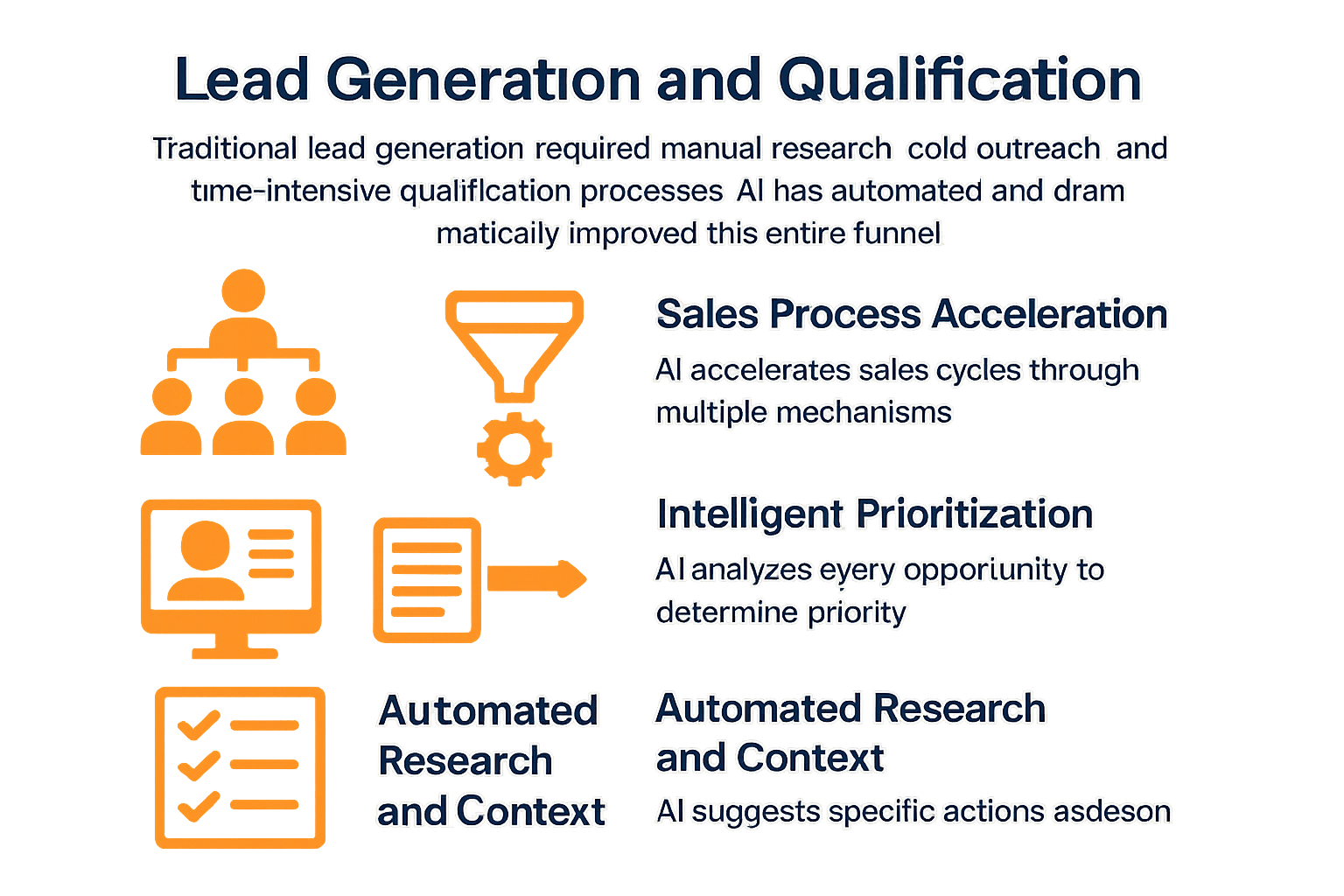
Traditional lead generation required manual research, cold outreach, and time-intensive qualification processes. AI has automated and dramatically improved this entire funnel.
Modern CRM systems now employ AI agents that autonomously identify potential customers, research company information, analyze buying signals, and even initiate personalized outreach. Lead management in Dynamics 365 Sales helps determine if a lead or prospect is a good fit for your product or service, with AI-powered capabilities for research, outreach, prospecting, and qualifying leads, ensuring that sales efforts focus on activities with the highest impact.
The impact is substantial. Instead of sales representatives spending hours researching prospects and crafting individual emails, AI agents handle the initial stages automatically. Representatives receive pre-qualified leads with comprehensive context, allowing them to focus on high-value conversations that require human insight and relationship-building.
Sales Process Acceleration
Opportunity acceleration in Dynamics 365 Sales is designed to help sellers engage meaningfully with buyers and meet their goals by prioritizing actions that progress the deal, with AI streamlining and automating various tasks, ensuring that sellers never miss out on crucial actions.
AI accelerates sales cycles through multiple mechanisms:
Intelligent Prioritization AI analyzes every opportunity in the pipeline, considering factors like engagement history, budget signals, competitive dynamics, and historical patterns to prioritize which deals deserve immediate attention and which can wait.
Automated Research and Context Before every customer interaction, AI compiles relevant information from internal CRM data, external news sources, social media, and company databases, ensuring sales representatives enter conversations fully prepared.
Next-Best-Action Recommendations Rather than forcing sales teams to determine optimal next steps, AI suggests specific actions based on deal stage, customer behavior, and successful patterns from similar opportunities.
Content Generation AI drafts personalized proposals, generates quote documents, creates follow-up emails, and prepares presentation materials tailored to specific customer needs and conversation history.
Customer Service Enhancement
In 2025, CRMs will be vital for ensuring smooth deliveries, tracking ongoing engagement, and addressing post-sales issues, with this shift to a more holistic view of the customer improving satisfaction, loyalty, and long-term revenue.
AI transforms customer service from reactive problem-solving to proactive customer success:
24/7 Autonomous Support AI agents handle routine inquiries around the clock, resolving common issues without human intervention while seamlessly escalating complex problems to human agents with full context.
Knowledge Base Enhancement The Knowledge Base Agent helps customers enhance and expand their support resources in real time based on incoming tickets, working with the Customer Agent to fill knowledge gaps and help more customers self-serve.
Predictive Issue Resolution By analyzing usage patterns and historical data, AI identifies customers likely to encounter problems and proactively reaches out with solutions before issues escalate.
Marketing Personalization at Scale
AI-Powered Email uses your CRM data to create deeply personal messages for individual contacts for higher conversion, with segments and personalization unlocking dynamic, AI-driven segmentation that grows with your business.
Modern marketing automation powered by AI enables:
Hyper-Personalized Campaigns Instead of broad segment-based messaging, AI creates individually tailored content for each prospect based on their specific interests, behavior history, and stage in the buyer journey.
Optimal Timing and Channel Selection AI determines the best time and channel to reach each contact, analyzing past engagement patterns to maximize response rates.
Content Generation Across Channels AI creates email copy, social media posts, landing pages, and advertising content that maintains brand consistency while adapting to audience preferences.
Data Management and Quality
Perhaps AI's most underappreciated contribution is solving CRM's perennial challenge: data quality.
Automatic Data Capture AI that reads your email about the Chicago office expansion and updates your CRM automatically eliminates manual data entry. Email tracking, meeting notes, phone call summaries, and customer interactions flow automatically into the CRM without requiring manual logging.
Data Enrichment and Cleaning AI continuously enriches customer records with information from external sources, identifies and merges duplicate records, fills missing fields, and flags outdated information for review.
Intelligent Validation Rather than simple field validation rules, AI understands context and can identify illogical data entries, suspicious patterns, and potential errors before they corrupt the database.
3. Real-World AI CRM Examples: Leading Platforms in 2026
Creatio CRM: AI-Native No-Code CRM

Creatio has positioned AI and no-code automation at the core of its CRM ecosystem, combining workflow automation, generative AI, and composable applications within a unified platform.
Creatio AI Capabilities
Creatio AI delivers embedded intelligence across sales, marketing, and service operations, enabling users to generate emails, summarize interactions, create workflows, and automate repetitive business processes using natural language prompts.
By 2026, Creatio’s AI functionality has evolved into a more context-aware assistant capable of leveraging CRM records, communication history, process data, and third-party integrations to generate recommendations, automate decisions, and streamline customer engagement.
AI-Native No-Code Automation
Creatio’s strategy centers around AI-driven no-code development—allowing business users and operations teams to design workflows, applications, and automations without extensive technical expertise.
Its AI-powered automation tools enable organizations to build custom CRM experiences, automate lead routing, trigger intelligent follow-ups, and optimize service operations through low-code and no-code interfaces. This approach has made Creatio particularly attractive for mid-market and enterprise companies seeking faster deployment and operational flexibility.
Real-World Implementation
Creatio AI assists teams by automatically generating meeting summaries, drafting customer communications, recommending next-best actions, and identifying workflow bottlenecks across business processes.
The platform’s unified architecture also allows organizations to orchestrate complex workflows between CRM, ERP, marketing, and customer support systems while maintaining centralized visibility into customer journeys and operational performance.
Governance and Security
Creatio emphasizes enterprise-grade governance and secure AI adoption by providing role-based access controls, workflow transparency, and configurable automation permissions.
Its AI capabilities are designed to operate within organizational data boundaries, helping companies maintain compliance and data security while deploying intelligent automation at scale.
Pricing and Accessibility
Creatio offers modular pricing based on CRM products and workflow automation capabilities, with AI and no-code functionality integrated across different platform tiers. The platform positions itself as a flexible alternative for organizations seeking enterprise CRM functionality combined with rapid customization and AI-powered process automation.
Salesforce: Agentforce and Einstein AI
Salesforce has positioned AI at the absolute center of its CRM strategy with Agentforce and Einstein platforms.
Einstein AI Capabilities
Salesforce Einstein delivers trusted, extensible AI grounded in the fabric of the Salesforce Platform, allowing users to ask Einstein to write emails enriched with customer data, generate concise summaries of sales calls, and use actionable insights to inform conversations.
In 2026, Salesforce Einstein's predictive algorithms have become more adaptive and accurate, integrating not just CRM data but also external sources like ERP, marketing platforms, and e-commerce systems through the Data Cloud.
Agentforce: Autonomous AI Agents
Salesforce's big vision boils down to agentic AI—systems that plan, reason through problems, and execute tasks using your own business data as the fuel, with Agentforce released in late 2024 and reaching full stride with upgrades like Agentforce 3 by 2026.
Reports from the industry show CRM AI adoption jumping past 60% for fully funded projects, way beyond the pilot phase, and over 70% of customers now prefer texting a brand instead of picking up the phone, which Salesforce builds right into their platform.
Real-World Implementation
Einstein Conversation Insights with more advanced summarization and topic extraction allow sales leaders to turn hours of sales conversations into a 2-minute summary packed with trends, insights, and next steps.
The Einstein Trust Layer addresses one of businesses' biggest AI concerns—data security. Einstein Copilot's trust layer ensures data privacy and accuracy, preventing sensitive information from being stored in large language models.
Pricing and Accessibility
Salesforce's AI features come at various price points. Einstein predictive features are included in higher-tier subscriptions, while Agentforce autonomous agents require additional licensing. The investment reflects Salesforce's positioning as an enterprise-grade solution with comprehensive AI capabilities.
HubSpot: Breeze AI and Hybrid Human-AI Teams
HubSpot has taken a distinctive approach emphasizing hybrid collaboration between humans and AI.
Breeze AI Ecosystem
HubSpot unveiled their blueprint to building hybrid human-AI teams with over 200 product updates, where Breeze Assistant is an AI companion that works alongside GTM teams with web search, memory, file upload, and connections to teams' favorite apps like Google Workspace and Slack.
Breeze Studio is where you manage and customize Agents and Custom Assistants to work for your specific business needs, with the Breeze Marketplace allowing you to discover, browse, and install Agents and Custom Assistants.
Embedded AI Throughout the Platform
Embedded AI features across HubSpot's customer platform help humans focus on strategy, creativity, and closing deals, with AI built into the workflows teams already use—no context switching and no data gaps.
Marketing Studio and Campaign Creation
In Marketing Studio, marketers can work with AI to generate a full set of campaign assets and optimize their campaign, all from a collaborative canvas, with Answer Engine Optimization Strategy helping optimize how your brand appears in LLM answers.
Data Hub and Smart CRM
The new Data Hub brings together data from external sources and includes AI tools to connect, clean, and action data, with Data Studio using AI to turn scattered context into unified data just by adding a column, powering smarter segmentation, automation, and reporting across HubSpot.
Adoption Metrics
Content Hub—which heavily features Breeze AI capabilities—saw attachment rates surge from 13% to 54% during 2024, with Service Hub Enterprise portal adoption increasing 100% quarter-over-quarter in Q4, driven partly by Customer Agent capabilities.
HubSpot's internal deployment provides proof of concept, with the company's own support organisation now resolving 35% of tickets through AI agents, targeting 50%+ resolution rates in 2025.
Accessibility and Pricing
HubSpot's approach emphasizes accessibility. You can get started with Breeze Assistant and select Breeze features for free in HubSpot, with Breeze Agents and advanced AI capabilities available in premium editions of HubSpot's software throughout the customer platform.
Zoho CRM: Zia AI and Agent Studio
Zoho's AI assistant Zia has evolved from helpful feature to comprehensive AI ecosystem.
Zia's Core Capabilities
Zia assists in identifying repetitive business activities you can automate and suggests workflows, macros, and owner assignment automation, transforming CRM data into a range of valuable business insights.
Zia identifies and mitigates the risk of customer churn through churn scores, and for subscription-based records, Zia indicates the product or service from which a particular customer might churn.
Zia AI Agent Studio
In 2025, Zoho introduced a major leap forward with Zia AI Agent Studio, enabling users to build and deploy their own AI agents that can take action within Zoho, including retrieving records, updating data, and automatically creating tasks.
Zia uses Zoho's own hosted Large Language Model (LLM) to interpret instructions and perform relevant tasks, with users deciding which tools the agent can access, keeping data secure while enabling automation.
Generative AI Integration
The 2025 update includes generative AI for content creation, advanced predictive analytics, OpenAI-powered conversations, and context-aware smart prompts, with Zia no longer just reacting to data but actively shaping how you engage with customers.
Practical Applications
Practical examples include the Lead Generation Agent, which autonomously scans unread emails in Zoho Mail for sales inquiries and automatically creates corresponding leads in Zoho CRM, with the "Ask Zia" feature allowing users to execute complex, multi-step task chains using natural language prompts.
Revenue Impact
The practical outcome shows that 55% of Zoho CRM users directly credited Zia AI with contributing to revenue growth.
Cost Advantage
There are no hidden per-use fees for Zia, with AI features coming included as part of your Zoho apps, from Zoho CRM to Zoho Projects, Zoho Creator, and Zoho Books, helping businesses maximize ROI without added licensing costs.
Microsoft Dynamics 365: Copilot and Autonomous Agents
Microsoft has integrated AI deeply across its Dynamics 365 platform, leveraging the broader Microsoft 365 ecosystem.
Copilot for Dynamics 365
Dynamics 365 Sales sets a new standard for CRM by putting AI and Copilot at the heart of every sales process, with deep insights, predictive analytics, and automated lead engagement helping sellers focus on building relationships while autonomous agents handle the busywork.
Copilot is an AI assistant that helps sales teams be more productive and efficient in their daily work, with a chat interface that sellers can use to get a quick summary of their opportunity and lead records, catch up on updates, prepare for meetings, and read the latest news about their accounts.
Agentic Capabilities
AI assistants and agents not only help humans with day-to-day tasks but also act as proactive partners to drive better business outcomes, with the 2025 release wave 2 introducing new and improved capabilities that help organizations harness the full potential of this new era.
Sales Qualification Agent
The Sales qualification agent autonomously researches and engages with leads, helping sales teams quickly identify those with real purchase intent, and in this wave, the agent goes further—moving the lead closer to full qualification and boosting the team's opportunity pipeline with greater precision and impact.
Finance and Operations
Dynamics 365 Finance expands the capabilities of the Account Reconciliation Agent, which supports teams in effortlessly resolving voucher amount mismatches and extends support to include ledger not in subledger and subledger not in ledger exceptions.
Integration Advantage
Microsoft 365 Copilot integrates across apps, with AI Views in Copilot Search results delivering richer, context-aware summaries by incorporating relevant metadata, related resources, and suggested actions.
Pipedrive: Focused AI for Sales Teams
While Pipedrive may not have the most extensive AI feature set, the platform focuses on practical AI implementations for sales pipeline management.
Core Strengths
- AI-powered lead scoring based on engagement and fit
- Deal probability predictions using historical data
- Email intelligence suggesting optimal sending times
- Workflow automation recommendations
Pipedrive's approach emphasizes simplicity and usability, making AI accessible to small and medium-sized sales teams without overwhelming complexity.
monday.com CRM: Visual AI-Powered Workflows
Monday.com has integrated AI throughout its visual, flexible CRM platform.
Key AI Features
- Automated workflow suggestions based on board activity
- AI-generated project timelines and resource allocation
- Intelligent automations that adapt based on team behavior
- Predictive analytics for project completion and risk identification
The platform's strength lies in making AI accessible through its intuitive visual interface, allowing non-technical users to leverage powerful automation.
4. From Assistive AI to Agentic AI: The Paradigm Shift
Understanding the Shift
The evolution from assistive to agentic AI represents a fundamental change in how we interact with CRM systems.
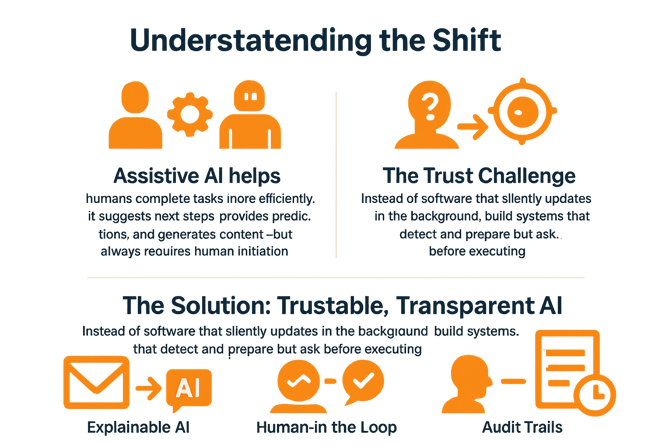
Assistive AI helps humans complete tasks more efficiently. It suggests next steps, provides predictions, and generates content—but always requires human initiation and approval.
Agentic AI takes autonomous action. It operates independently toward defined goals, making decisions and executing tasks without constant human oversight.
Self-driving CRMs where AI updates itself in the background, calendars change without you noticing, and project status shifts automatically means you stop thinking about your work. This represents both tremendous opportunity and significant risk.
The Trust Challenge
The problem with full autonomy is that "busywork" everyone hates might have been the work—when a sales rep manually logs a deal, they're forced to think about it, to assess if it's real, to notice the budget concerns in paragraph three.
This insight captures a crucial tension. Automation brings efficiency, but the act of manual work often creates valuable cognitive engagement. Complete automation risks creating a disconnected workforce that operates at a surface level without deep understanding.
The Solution: Trustable, Transparent AI
Instead of software that silently updates in the background, build systems that detect and prepare but ask before executing—the AI reads your email, identifies the deal, extracts the data, and presents it: "I found this opportunity. Approve?" with one click to confirm, but you still see it.
Leading CRM platforms are implementing this balanced approach:
Explainable AI Users don't need "the AI updated your CRM"—they need "the AI found this email where the prospect said 'send the contract,' extracted these three data points, and moved the deal to Proposal. Here's the exact text. Approve?"
Human-in-the-Loop Critical decisions still require human approval, but AI handles the research, analysis, and recommendation, dramatically reducing time while maintaining oversight.
Audit Trails Every AI action is logged with reasoning, allowing teams to understand why decisions were made and learn from AI behavior over time.
Competitive Differentiation Through Trust
In a world where every AI can automate, trust is the only moat—your competitor's AI reads emails just as fast as yours, but can it show its work, prove it's not hallucinating, and learn when it's wrong?
The CRM vendors winning in 2026 aren't those with the fastest AI—they're those with the most trustworthy AI. This requires:
- Transparent decision-making processes
- Clear explanations for recommendations
- Easy override mechanisms
- Continuous learning from corrections
- Robust security and privacy protections
5. The Data Challenge: AI's Foundation and Achilles Heel
The Data Quality Imperative
One of the biggest challenges will be moving beyond simple AI features like chatbots to truly transformative predictive and generative AI, which requires organizations to fix their data issues, with core operational failures stemming from mishandled adoption and poor data quality plague organizations.
AI systems are only as good as the data they're trained on and operate with. This creates a catch-22: organizations need clean, comprehensive data to leverage AI effectively, but manual data entry and maintenance—the traditional approach—is exactly what teams want AI to replace.
Common Data Challenges
Siloed Information Customer data scattered across CRM, marketing automation, customer support, accounting, and other systems prevents AI from developing comprehensive customer understanding.
Inconsistent Standards Different teams entering data in different formats, using varied terminology, and following disparate processes creates noise that AI must filter through.
Incomplete Records Missing critical information like accurate contact details, company relationships, or interaction history limits AI's ability to provide relevant recommendations.
Outdated Information Customers change roles, companies get acquired, contact information becomes invalid—and stale data leads to embarrassing and ineffective AI-powered outreach.
The Solution: Unified Data Platforms
Most businesses are making 100% of their decisions with only 20% of the data—the rest is scattered across systems, trapped in conversations, or just plain bad—the new Data Hub brings business data together, structured, unstructured, and external, to give GTM teams and their AI unified, clean, and complete context.
Leading CRM vendors are addressing this through unified data platforms:
Salesforce Data Cloud Data Cloud is shaping up to be a need to have, not a nice to have, with Agentforce dependency meaning AI agents need unified, harmonized data since you can't run sophisticated automation on fragmented data sources.
HubSpot Data Hub HubSpot's approach focuses on making data unification accessible to mid-market companies without requiring extensive IT resources.
Microsoft Dataverse Dynamics 365 leverages Microsoft's Dataverse for unified data across business applications, providing a strong foundation for AI capabilities.
Investment Requirements
IDC projects that by 2026, nearly half of new CRM-related investment will go into data architecture, AI infrastructure, and analytics to support these needs.
Organizations cannot treat data infrastructure as an afterthought. Success with AI-powered CRM requires:
- Dedicated data governance frameworks
- Regular data quality audits and cleanup
- Integration across all customer-touching systems
- Investment in CDP (Customer Data Platform) technology
- Clear data ownership and stewardship
6. The Human Element: What AI Can't Replace
The Irreplaceable Skills
Despite AI's remarkable capabilities, certain aspects of customer relationship management remain distinctly human:
Complex Relationship Building AI can facilitate connections, but building trust, navigating organizational politics, and developing long-term partnerships require human empathy, intuition, and relationship skills.
Strategic Negotiation While AI can analyze past deals and suggest pricing strategies, high-stakes negotiations involving multiple stakeholders, competing priorities, and nuanced trade-offs demand human judgment.
Creative Problem-Solving AI excels at pattern recognition and optimization within defined parameters, but breakthrough solutions to novel customer challenges often require creative thinking that transcends historical data.
Ethical Decision-Making Customer situations sometimes present ethical dilemmas that can't be resolved through algorithms—they require human values, contextual understanding, and moral reasoning.
The Augmentation Model
HubSpot believes the future belongs to businesses that build hybrid human-AI teams where smart people plus smart systems create exponential growth, with AI transformation being about whether you'll lead that change or be left behind.
The most successful organizations view AI not as human replacement but as human augmentation:
AI Handles:
- Routine data entry and logging
- Initial research and information gathering
- Pattern recognition and predictions
- Content generation and personalization at scale
- 24/7 monitoring and alerts
Humans Focus On:
- Strategic relationship development
- Complex problem-solving
- High-stakes negotiations
- Creative campaign development
- Coaching and team development
Training for the AI Era
Gartner expects that by the end of 2026, more than 80% of enterprise sales cycles will involve at least one shared digital workspace, fundamentally changing how sales teams work.
Organizations must invest in training that helps teams:
- Understand AI capabilities and limitations
- Effectively prompt and direct AI systems
- Interpret AI recommendations critically
- Override AI when appropriate
- Combine AI insights with human judgment
7. Industry-Specific CRM Transformation
Healthcare
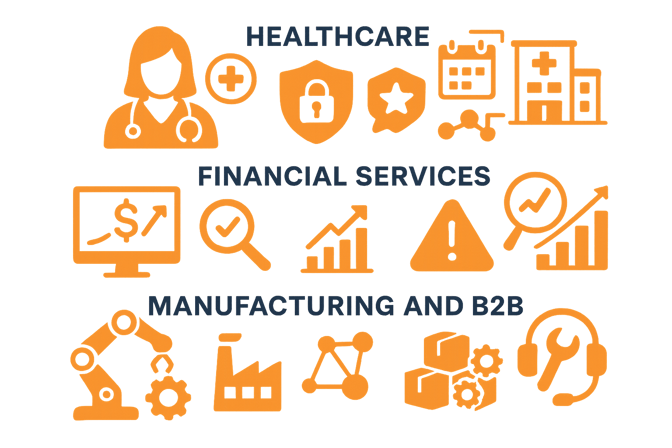
Healthcare CRMs now use agents that understand HIPAA compliance, with domain-trained agents providing ready-to-use automation for case management while contextual data models integrate sector-specific datasets, making AI recommendations more accurate and relevant.
Healthcare organizations benefit from AI that:
- Automatically identifies patients requiring follow-up care
- Predicts appointment no-shows and proactively reschedules
- Generates HIPAA-compliant communication
- Analyzes patient feedback for quality improvement
- Coordinates care across multiple providers
Financial Services
In the financial services sector, companies like Goldman Sachs employ custom AI models to detect potential fraud, manage risk, and optimize investment portfolios.
Financial services CRM powered by AI enables:
- Real-time compliance monitoring
- Automated risk assessment for client relationships
- Personalized investment recommendations
- Fraud detection and prevention
- Regulatory reporting automation
Manufacturing and B2B
Vertical CRMs integrate sector-specific datasets and deliver ready-to-use automation for field service and complex supply chains, enabling businesses to deploy CRMs that reflect their operational realities rather than adapting generic platforms.
Manufacturing organizations leverage AI for:
- Predictive maintenance scheduling
- Supply chain disruption prediction
- Complex quotation and configuration
- Multi-stakeholder deal coordination
- After-sales service optimization
8. Implementation Challenges and Solutions
Common Implementation Obstacles
Change Management Resistance As AI becomes embedded across CRM workflows, the challenge in 2026 shifts from adoption to execution, forcing organizations to confront data readiness, platform scale, and human interaction.
Teams accustomed to working certain ways resist new AI-powered processes, especially if they don't understand how AI makes decisions or fear being replaced.
Integration Complexity Connecting CRM AI capabilities with existing tech stacks, legacy systems, and custom applications requires technical expertise and careful planning.
Cost Concerns Salesforce's 2025 AI strategy marks a decisive move toward agentic systems, but Agentforce isn't just another AI add-on—it's a structured framework that requires investment beyond base CRM licensing.
Skill Gaps Few organizations have teams experienced in prompt engineering, AI governance, and AI-human workflow design.
Success Strategies
Start with Specific Use Cases Organizations should focus on data foundations first, start with narrow, well-defined use cases, and set realistic expectations about timelines and effort.
Rather than attempting comprehensive AI transformation, begin with one high-impact use case:
- Automating meeting notes and CRM updates
- AI-powered lead scoring and prioritization
- Automated email drafting for common scenarios
- Customer churn prediction and prevention
Invest in Data Infrastructure First Organizations should revisit their Einstein implementations, evaluate their Data Cloud strategy, and think about integration architecture.
No amount of AI sophistication can overcome poor data quality. Prioritize:
- Data cleaning and deduplication
- System integration and unification
- Clear data governance policies
- Regular data quality monitoring
Focus on User Adoption Organizations should use the Agentic Maturity Model to assess their current level, identify their biggest blockers (usually data quality or process clarity), and plan expansion systematically, not opportunistically.
Technology deployment without adoption equals wasted investment. Ensure:
- Comprehensive training programs
- Clear documentation and support resources
- Champions within each team
- Regular feedback collection and iteration
Measure and Communicate ROI Establishing clear baselines for cycle time, win rate, and satisfaction before implementation is becoming standard practice, with measurement determining which initiatives survive budget reviews in 2026.
Track metrics that demonstrate value:
- Time saved on administrative tasks
- Increase in deals closed or conversion rates
- Improvement in customer satisfaction scores
- Reduction in customer churn
- Revenue impact per sales representative
9. The Future Roadmap: What's Coming in Late 2026 and Beyond (Continued)
Agent-to-Agent Communication
The long-term vision for Zia includes Agent-to-Agent (A2A) communication capabilities on the roadmap, which is the foundation for true autonomous process execution in 2026.
Future CRM systems will feature multiple specialized AI agents that communicate with each other, coordinating complex workflows without human intervention. Imagine:
- A lead qualification agent identifying a high-value prospect
- Automatically communicating with a research agent to gather detailed company information
- Passing complete context to an outreach agent that crafts personalized communication
- Coordinating with a scheduling agent to book meetings at optimal times
- Updating a reporting agent that tracks campaign performance
This inter-agent orchestration promises to handle entire business processes end-to-end, with humans involved only at critical decision points or when exceptions require judgment.
Multimodal AI Capabilities
The next frontier involves CRM systems that process not just text but images, video, voice, and other data types simultaneously.
Voice-First Interactions Sales representatives will conduct entire CRM interactions through voice commands while driving between meetings, with AI transcribing, interpreting, and executing complex multi-step instructions.
Visual Intelligence AI will analyze product photos, facility images, and visual presentations to extract insights—identifying equipment models from photos, assessing facility conditions, or evaluating competitive positioning from visual content.
Sentiment Analysis Through Multiple Channels Beyond analyzing email text, future CRM AI will assess voice tone in recorded calls, facial expressions in video meetings, and body language cues to provide comprehensive sentiment analysis.
Predictive Business Intelligence
AI systems will move beyond predicting individual deal outcomes to forecasting broader business patterns:
- Market trend identification before they become obvious
- Early warning systems for industry disruptions
- Competitive intelligence gathered from patterns across customer interactions
- Product development insights derived from customer conversation analysis
Embedded AI Everywhere
The distinction between "CRM system" and "AI-powered tools" will disappear entirely. AI will be so thoroughly integrated into every function that users won't think about whether they're "using AI"—they'll simply work more effectively.
Every button, every field, every workflow will have intelligence embedded. The CRM won't be a tool you use—it will be a collaborative environment where AI and humans work seamlessly together.
10. Making the Transition: Practical Guidance for Organizations
Assessment: Where Are You Now?
Before embarking on AI-powered CRM transformation, organizations need honest assessment of their current state.
Data Maturity Evaluation
- How clean and complete is your existing CRM data?
- Are customer records integrated across systems or siloed?
- Do you have consistent data entry standards and enforcement?
- How much manual effort currently goes into data maintenance?
Technical Infrastructure Audit
- What is your current CRM platform and version?
- Which systems need to integrate with your CRM?
- What are your data storage and processing capabilities?
- Do you have API access and integration expertise?
Team Readiness Assessment
- How comfortable is your team with current CRM functionality?
- What is the general attitude toward AI and automation?
- Do you have internal champions who can drive adoption?
- What training resources and capacity do you have?
Use Case Prioritization
- Which business problems cause the most pain today?
- Where would AI provide the highest immediate value?
- Which processes are repetitive and rules-based?
- What quick wins could build momentum?
The Phased Implementation Approach
Successful AI CRM transformation follows a deliberate, phased approach rather than attempting everything simultaneously.
Phase 1: Foundation (Months 1-3)
- Clean and consolidate existing CRM data
- Establish data governance policies and procedures
- Integrate critical systems (email, calendar, core business applications)
- Select initial AI use case with clear ROI potential
- Form implementation team with executive sponsorship
Phase 2: Pilot (Months 4-6)
- Deploy first AI capability to small, enthusiastic user group
- Provide intensive training and support
- Collect detailed feedback and usage metrics
- Identify and resolve integration issues
- Document best practices and lessons learned
- Measure and communicate early wins
Phase 3: Expansion (Months 7-12)
- Roll out successful pilot features to broader organization
- Add second and third AI capabilities based on learnings
- Develop internal training materials and programs
- Establish centers of excellence or power user networks
- Continue measuring and optimizing based on data
Phase 4: Optimization (Months 13-18)
- Implement more advanced AI features like autonomous agents
- Enable agent-to-agent communication for complex workflows
- Customize AI behavior based on organizational learnings
- Integrate AI across entire customer lifecycle
- Shift from implementation to continuous improvement mindset
Building the Right Team
AI-powered CRM transformation requires diverse expertise that most organizations don't have in-house.
Core Team Roles:
Executive Sponsor A C-level leader who provides strategic direction, removes organizational obstacles, secures budget, and champions the initiative across the company.
CRM Administrator/Architect Technical expert who understands platform capabilities, manages configuration and customization, oversees integrations, and maintains system health.
Data Steward Responsible for data quality, governance policies, integration mapping, and ensuring AI systems have clean, reliable information.
Change Management Lead Drives user adoption through training programs, communication strategies, feedback collection, and addressing resistance.
Business Process Owner Subject matter expert from sales, marketing, or service who defines requirements, validates AI behavior, and ensures solutions address real business needs.
AI/Analytics Specialist Understands AI capabilities and limitations, configures AI features appropriately, monitors model performance, and optimizes over time.
Organizations should also establish an AI governance committee that includes legal, compliance, IT security, and business leadership to oversee ethical AI use, data privacy, security protocols, and risk management.
Vendor Selection Criteria
Choosing the right AI-powered CRM platform requires evaluating factors beyond traditional CRM selection:
AI Capability Maturity
- How advanced are the platform's current AI features?
- What's on the near-term roadmap?
- Are AI capabilities built-in or third-party integrations?
- How frequently are AI features updated?
Data Architecture
- Does the platform include unified data capabilities?
- How does it handle data from multiple sources?
- What are the data storage and processing limits?
- Is there a customer data platform (CDP) component?
Explainability and Trust
- Can the AI explain its recommendations and decisions?
- Are there audit trails for AI actions?
- How easily can users override AI suggestions?
- What security and privacy protections exist?
Integration Ecosystem
- Which business applications integrate natively?
- Is there robust API access for custom integrations?
- Are pre-built connectors available for your tech stack?
- How difficult is it to maintain integrations?
Total Cost of Ownership
- What's included in base pricing versus add-ons?
- Are there per-user, per-agent, or usage-based fees?
- What implementation and training costs should you expect?
- How do costs scale as you add users and capabilities?
Vendor Stability and Vision
- Is the vendor financially stable with long-term viability?
- Do they have a clear AI strategy and vision?
- How actively are they innovating?
- What's their track record with major platform transitions?
Managing Expectations
Perhaps the most critical success factor is setting realistic expectations with all stakeholders.
What AI-Powered CRM Will Do:
- Dramatically reduce time spent on administrative tasks
- Provide data-driven insights and recommendations
- Automate routine customer interactions
- Improve data quality and completeness
- Enable more personalized customer engagement at scale
- Help teams prioritize high-value activities
What AI-Powered CRM Won't Do:
- Replace the need for skilled sales, marketing, and service professionals
- Magically fix broken business processes
- Eliminate the need for management and coaching
- Work perfectly from day one without iteration
- Succeed without clean data and proper configuration
- Remove the importance of human judgment and relationships
Organizations should communicate openly about the transition period, expected learning curve, and ongoing optimization requirements. Transformation takes time, and maintaining stakeholder support requires demonstrating progress while being honest about challenges.
Measuring Success
Establish clear, measurable objectives before implementation and track them consistently:
Efficiency Metrics
- Time saved per day on administrative tasks
- Reduction in manual data entry
- Decrease in time to complete key processes
- Improvement in data quality scores
Effectiveness Metrics
- Increase in conversion rates at each funnel stage
- Improvement in forecast accuracy
- Growth in average deal size
- Reduction in sales cycle length
- Increase in customer satisfaction scores
Adoption Metrics
- Percentage of team actively using AI features
- Frequency of AI feature usage
- Reduction in support tickets related to CRM
- Increase in data completeness
Business Impact Metrics
- Revenue growth per sales representative
- Customer lifetime value improvement
- Reduction in customer acquisition cost
- Decrease in customer churn rate
- Overall revenue impact
Regular reporting on these metrics to executive leadership, board members, and team members helps maintain momentum and justify continued investment.
Conclusion: Embracing the Evolution
The question that opened this article—"Is CRM dying or evolving?"—now has an unambiguous answer. CRM isn't dying. It's evolving into something more powerful, more intelligent, and more central to business success than ever before.
The transformation we're witnessing in 2026 represents a fundamental shift in how organizations manage customer relationships. AI isn't simply an add-on feature or a nice-to-have enhancement. It's becoming the core operating system through which customer-facing teams work, make decisions, and drive results.
The Imperative for Action
Organizations face a critical decision point. Those who embrace AI-powered CRM now will develop competitive advantages that compound over time—more efficient teams, deeper customer insights, faster response times, and more personalized engagement. Those who delay risk falling increasingly behind as AI-enabled competitors move faster and serve customers better.
The good news is that the technology has matured significantly. Leading platforms like Salesforce, HubSpot, Zoho, and Microsoft Dynamics 365 offer robust, proven AI capabilities that deliver measurable results. The infrastructure, best practices, and implementation frameworks exist to support successful transitions.
The Human-AI Partnership
The future of CRM isn't about AI replacing humans—it's about AI empowering humans to focus on what they do best. While AI handles data entry, routine communications, research, and pattern recognition, people can invest their energy in strategic thinking, creative problem-solving, relationship building, and complex decision-making.
This partnership only works when organizations build it thoughtfully. Trust, transparency, and explainability matter as much as raw AI capability. Teams need to understand how AI makes decisions, when to trust its recommendations, and how to override it when necessary. The most successful implementations balance automation with human judgment, efficiency with engagement, and innovation with stability.
The Path Forward
For organizations beginning this journey, the path forward involves several key steps:
Start with strategy, not technology. Define your business objectives, identify your biggest pain points, and determine where AI can deliver the most value before selecting platforms or features.
Invest in your foundation. Clean data, integrated systems, and clear processes matter more than sophisticated AI algorithms. Build the infrastructure that allows AI to succeed.
Think phased, not all-at-once. Begin with targeted use cases that deliver quick wins and build momentum. Learn, iterate, and expand based on results and feedback.
Prioritize people. Technology succeeds or fails based on adoption. Invest in training, communication, change management, and building internal champions.
Measure relentlessly. Establish clear metrics, track them consistently, and use data to guide decisions about what's working and what needs adjustment.
Stay current. The AI landscape continues evolving rapidly. Maintain awareness of new capabilities, emerging best practices, and lessons learned by others in your industry.
Looking Ahead
As we move through 2026 and beyond, AI-powered CRM will continue evolving. Agent-to-agent communication will enable unprecedented automation. Multimodal AI will process voice, video, and visual information alongside text. Predictive capabilities will become more sophisticated and accurate. The boundary between CRM and other business systems will blur as unified data platforms create seamless environments.
These advances will bring new opportunities and new challenges. Organizations that approach AI thoughtfully—balancing innovation with responsibility, automation with human judgment, and efficiency with relationship quality—will thrive.
The evolution of CRM through AI represents one of the most significant transformations in business technology history. The question isn't whether to participate in this evolution but how quickly and effectively you can adapt.
The future of customer relationship management is here. It's intelligent, autonomous, and remarkably capable. And it's waiting for organizations ready to embrace it.
Additional Resources
For Further Learning:
- Anthropic's documentation on AI best practices: https://docs.claude.com
- Salesforce Agentforce documentation and training resources
- HubSpot Academy courses on AI-powered marketing and sales
- Gartner research on CRM market trends and predictions
- McKinsey insights on AI in customer-facing operations
Key Vendor Resources:
- Salesforce: https://www.salesforce.com/einstein/
- HubSpot: https://www.hubspot.com/products/artificial-intelligence
- Zoho: https://www.zoho.com/crm/zia.html
- Microsoft: https://www.microsoft.com/en-us/dynamics-365/ai
- Creatio: https://www.creatio.com/crm
Industry Communities:
- CRM professional groups on LinkedIn
- Vendor-specific user communities and forums
- AI in Sales and Marketing conferences
- Local CRM user groups and meetups
The transformation is underway. Your move.

.png)